What happens in the plant
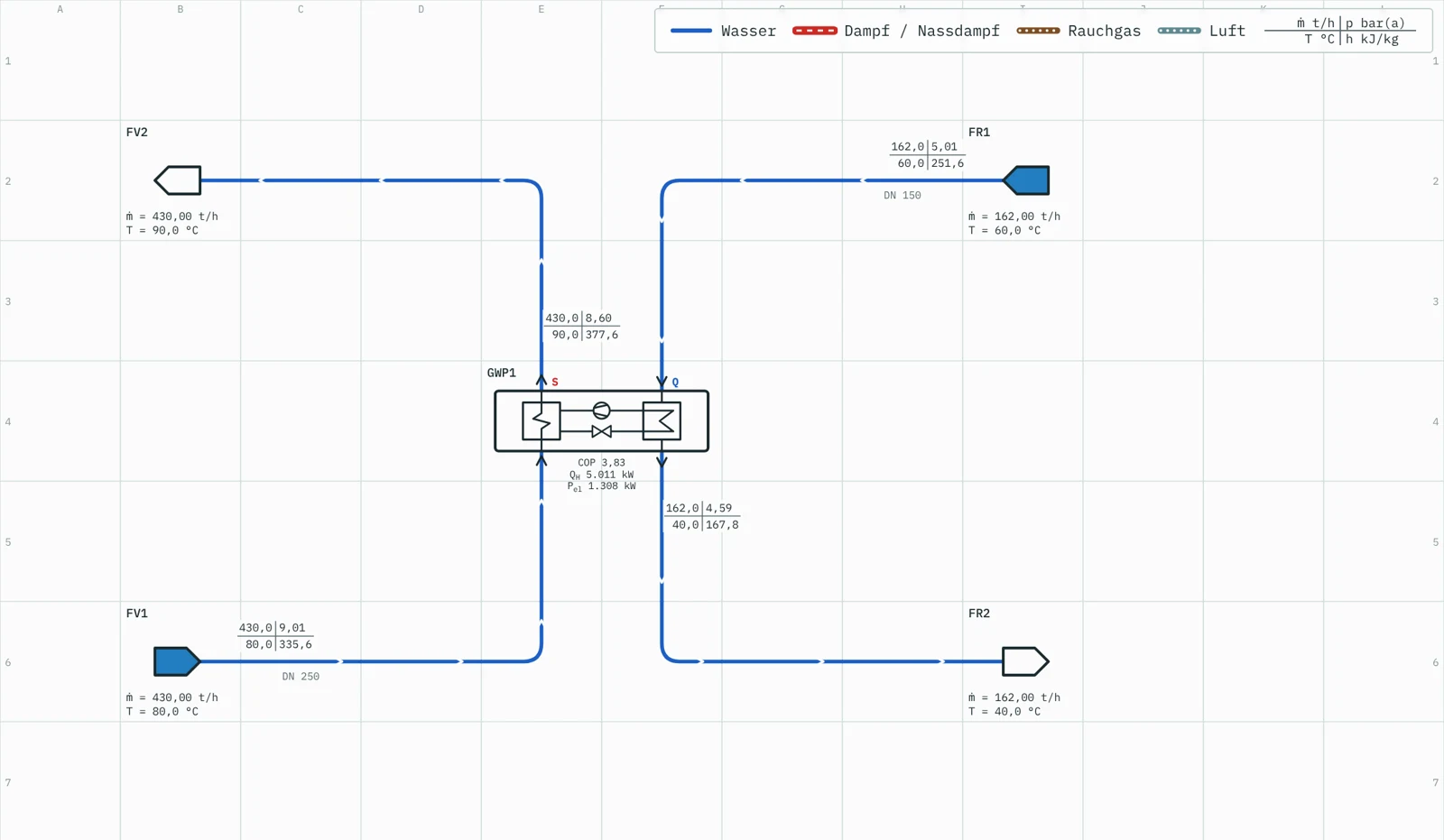
The large heat pump GWP1 uses the district heating return itself as the heat source: a side stream at 60 °C flows through the evaporator and returns at 40 °C. The condenser transfers this heat plus the drive energy of the compressor to a flow side stream, which is raised from 80 to 90 °C.
A real refrigeration cycle is calculated with refrigerant R1234ze(E) and a centrifugal compressor: evaporation, superheating, compression, condensation and subcooling with properties from CoolProp, water to IAPWS-IF97.
5.0 MWheat output in winter
COP 3.8at 1.3 MW power in winter
≈ 3.7seasonal performance factor over three load cases
Results per load case
| Load case | Flow side stream | Return side stream | Heat | Power | COP |
|---|
| Winter (rated load) | 430 t/h | 162 t/h | 5.0 MW | 1.31 MW | 3.83 |
| Transition | 258 t/h | 97 t/h | 3.0 MW | 0.83 MW | 3.62 |
| Summer | 129 t/h | 49 t/h | 1.5 MW | 0.45 MW | 3.32 |
The temperatures stay the same in all load cases; only the mass flows fall with the heat demand. That the COP still drops is due to the part-load behaviour of the centrifugal compressor.
How to use the example
- Click “Open in the tool” – the diagram opens as a project of its own.
- Switch the load case at the top and compare COP, heat and power on the component.
- Click component GWP1: change refrigerant, circuit, compressor type and flow temperature, read load ratio and cycling.
- Change the network temperatures at FV1 and FR1 – every kelvin less flow temperature improves the COP.
What the example does not cover
Investment, power and heat prices, subsidies and grid fees. For these there is the large heat pump calculator with heat cost, savings compared with a gas boiler, CO₂ and payback.
Frequently asked questions
Why does the COP fall in summer although the temperatures stay the same?
Because the centrifugal compressor works less efficiently at part load. In the example the COP falls from 3.8 in winter to 3.3 in summer. Below its minimum load it has to cycle – the tool shows this in the component and compares other compressor types.
What seasonal performance factor results?
With the operating hours of the example (3,000 h winter, 3,000 h transition, 2,000 h summer) around 3.7: about 27,000 MWh of heat from 7,300 MWh of power.
Can I calculate a different refrigerant or circuit?
Yes. In the large heat pump component you choose the refrigerant (e.g. R717 ammonia, R1234ze(E), R1233zd(E)), single-stage or two-stage circuit with economiser and the compressor type. The properties come from CoolProp.
What does the tool cost?
Nothing. The heat balance tool can be used without sign-up; students with a university e-mail address use all features free of charge.
← All heat balance examples · Free calculators