What happens in the plant
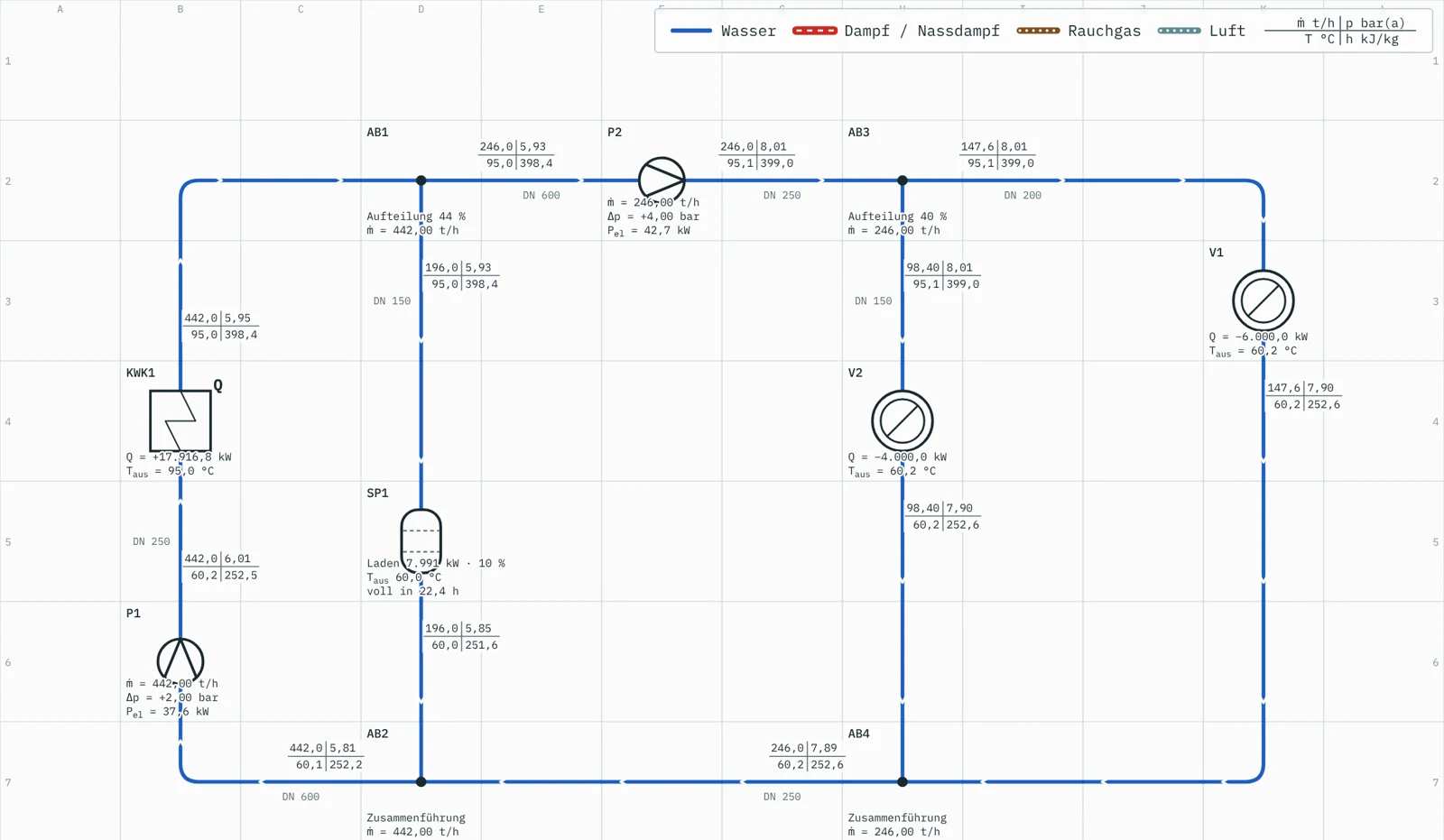
The CHP plant KWK1 heats the district heating water from 60 to 95 °C, pump P1 circulates it through the generation circuit. At tee AB1 the flow splits: part goes via network pump P2 to consumers V1 and V2, the rest through the thermal store SP1 (5,000 m³).
The store is connected in parallel to the network. If the CHP plant delivers more than the network takes, the surplus flows warm into the top of the store and displaces cold water at the bottom. When the CHP plant ramps down, the direction reverses – the store releases warm water into the network.
18 → 9 MWCHP heat from “full” to “part load”
≈ 200 MWhusable storage heat (5,000 m³, 95/60 °C)
22 huntil the store is full at 8 MW
Results per load case
| Load case | CHP heat | Network (V1 + V2) | Store | Generation circuit | Network circuit |
|---|
| Power price high | 17.9 MW | 10.0 MW | charging 8.0 MW | 442 t/h | 246 t/h |
| Power price low | 8.9 MW | 16.0 MW | discharging 7.0 MW | 221 t/h | 393 t/h |
The energy balance closes in both cases: generation plus or minus storage equals the network’s heat demand. Both pumps together need around 80 kW of power.
How to use the example
- Click “Open in the tool” – the diagram opens as a project of its own.
- Switch the load case at the top between “power price high” and “power price low”.
- Look at the schedule on store SP1: level, charging and discharging time.
- Change the storage volume, the network load at V1/V2 or the CHP output and see how the mass flows shift.
What the example does not cover
Power generation and efficiencies of the CHP plant, hourly power prices, heat losses of the store, stratification and mixing zone, pressure maintenance. How much a store saves together with an electrode boiler or heat pump in cheap power hours is calculated by the power-to-heat calculator.
Frequently asked questions
Why does a flexible CHP plant need a thermal store?
The CHP plant should generate power when it is expensive, but the network needs heat when it is cold. The store decouples the two: at high power prices the CHP runs at full load and stores the surplus; at low power prices it ramps down and the store fills the gap.
How large is the store in the example?
5,000 m³ of hot water between 95 and 60 °C. That is roughly 200 MWh of usable heat (5,000 m³ × 975 kg/m³ × 4.19 kJ/(kg·K) × 35 K). With 8 MW charging power it is full from 10 % level in just over 22 hours.
Does the example also calculate the CHP plant’s power?
No. The CHP plant is simplified here as a heat generator; the example shows the heat side: mass flows, outputs and the role of the store. Engine or turbine CHP with power and exhaust heat are available as separate examples in the tool (CHP unit, gas turbine).
What does the tool cost?
Nothing. The heat balance tool can be used without sign-up; students with a university e-mail address use all features free of charge.
← All heat balance examples · Free calculators